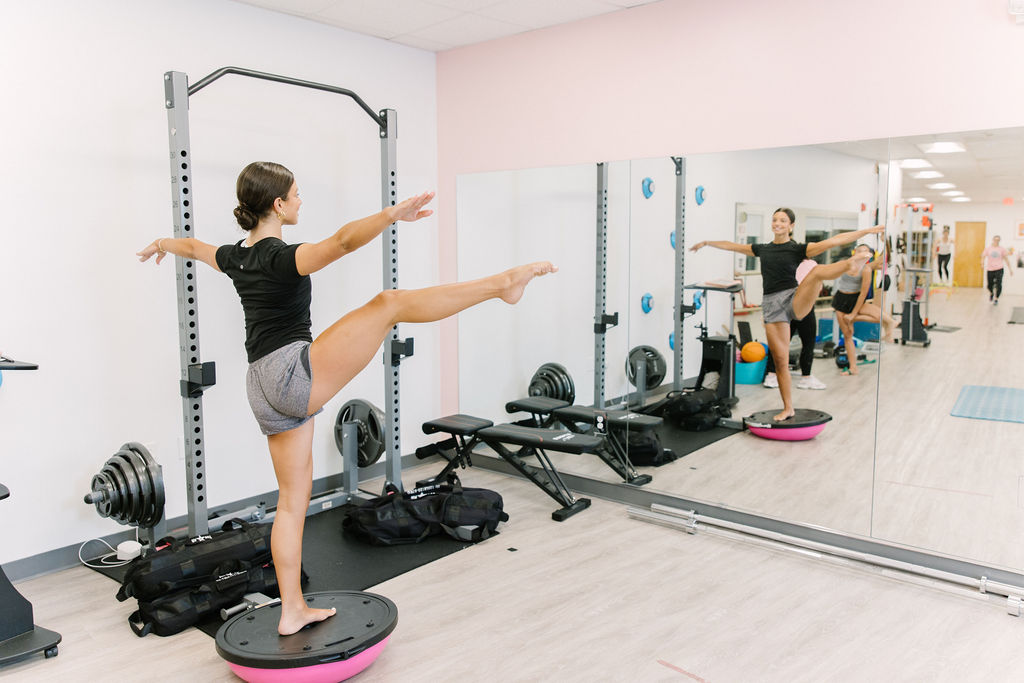
Snapping Hip in Dancers, Skaters, and Gymnasts: What
Parents and Athletes Should Know
A “snapping” feeling in the front or side of the hip is common in artistic athletes. In one study of ballet dancers, 90% said they had snapping hip at some point. It can be annoying, sometimes painful, and often shows up more in student dancers who are training hard and growing fast.
The good news is that snapping hip is usually not dangerous, and most athletes get better with physical therapy and small changes to how they move.
What Is Snapping Hip?
Snapping hip happens when a tendon slides over a bone and makes a pop or click. There are a few types, but the most common in artistic athletes involve:
● The iliopsoas (a deep hip flexor muscle in the front of the hip)
● The TFL (a muscle on the outside of the hip)
These tendons work overtime in dance, skating, and gymnastics, especially with high kicks, développés, battements, jumps, and turnout. Over time, they can get irritated and start snapping.
Why Artistic Athletes Get It More Often
Artistic athletes use their hips differently than most sports:
● Extreme flexibility and big ranges of motion
● Repetitive high kicks and hip flexion
● Turnout demands
● Growing bodies especially in student dancers developing strength
● Higher training loads
Some dancers also have mild hip dysplasia, which means they rely more on muscles for stability, making snapping more likely.
Signs Snapping Hip Might Be Developing
Parents and athletes often notice:
● A visible or audible “snap” when lifting or lowering the leg
● Snapping that used to be painless but is now sore
● More snapping after a growth spurt or increase in training
● Trouble controlling turnout without arching the back
● Tightness in the front or outside of the hip
What at Physical Therapist will Look At
● Hip strength and control: Especially the deep hip flexors and the glute muscles
that stabilize the pelvis.
● Turnout mechanics: “Forced turnout” can overload the iliopsoas, TFL, and IT
band.
● Balance and fatigue: Tests like the Y Balance or hop tests show how well the
hip holds up under dance‐like demands.
● Specific hip tests: These help identify what structures are irritated.
All of these tests come straight from research on dancers and artistic athletes.
What Treatment Looks Like
Most athletes recover fully with conservative treatment. A study of 653 people with snapping hip found that every single one improved without surgery or injections.
Treatment usually includes:
1. Strengthening key muscles: Deep hip flexors, Glute medius, Core stabilizers. Stronger hips = less snapping and less irritation.
2. Releasing tight muscles: Iliopsoas or TFL (not always! Sometimes muscles feel “tight” but are really over lengthened, irritated, and/or weak)
3. Improving movement patterns: Especially turnout control and avoiding excessive arching in the lower back.
4. Dance‐specific modifications: Temporarily reducing the volume or range of motion in: Passé, Développé, Grand battement. This gives the irritated tendon time to calm down.
5. Motor control training: Research shows this can even increase the size of the iliopsoas muscle, which may help prevent symptoms from returning.
When to See a PT
A PT visit is helpful when:
● Training load has increased
● Snapping starts to becomes painful
● The athlete starts avoiding certain movements
● The athlete is growing quickly
Early care keeps small issues from turning into bigger ones. If you’re noticing snapping, clicking, or pain in your hip, especially during dance, skating, or gymnastics, don’t wait it out or push through. Our team understands the unique
demands of artistic athletes and can guide you back to strong, confident movement that meets the demands of your sport. Reach out today and let’s get you back in motion.
References:
1. Curley, A. J., Engler, I. D., McClincy, M. P., & Mauro, C. S. (2022). Hip pain in ballet
dancers: Evaluation and management. Journal of the American Academy of Orthopaedic
Surgeons, 30(23), 1123–1130. https://doi.org/10.5435/JAAOS-D-22-00528
2. Emery, S., Cook, J., Ferris, A.-R., Smith, P., & Mayes, S. (2019). Hip flexor muscle size
in ballet dancers compared to athletes, and relationship to hip pain. Physical Therapy in
Sport, 38, 146–151.
3. Kivlan, B. R., Carcia, C. R., Clemente, F. R., Phelps, A. L., & Martin, R. L. (2013).
Reliability and validity of functional performance tests in dancers with hip dysfunction.
The International Journal of Sports Physical Therapy, 8(4), 360–369.
4. Laible, C., Swanson, D., Garofolo, G., & Rose, D. J. (2013). Iliopsoas syndrome in
dancers. The Orthopaedic Journal of Sports Medicine, 1(3), 2325967113500638.
https://doi.org/10.1177/2325967113500638htts://doi.rg/10.1016/j.ptsp.2019.05.003
5. Lategan, R., Berner, K., & Brink, Y. (2025). Balance and strength in nonprofessional
dancers with snapping hip: A cross-sectional study. South African Journal for Research
in Sport, Physical Education and Recreation, 47(2), 62–82.
6. Nolton, E. C., & Ambegaonkar, J. P. (2018). Recognizing and managing snapping hip
syndrome in dancers. Medical Problems of Performing Artists, 33(4), 242–247.
7. Vandeputte, F.-J., Driesen, R., Timmermans, A., & Corten, K. (2025). Evaluation of
clinical tests to diagnose iliopsoas tendinopathy. Published online May 19, 2025.
(Original work received October 16, 2024; accepted April 9, 2025). Copyright © 2025
The Author(s), Wolters Kluwer Health.https://doi.org/10.21091/mppa.2018.4042